
2026-10-11 · Joe Root
How Water and Drainage Cause Foundation Problems (and How to Fix Them)
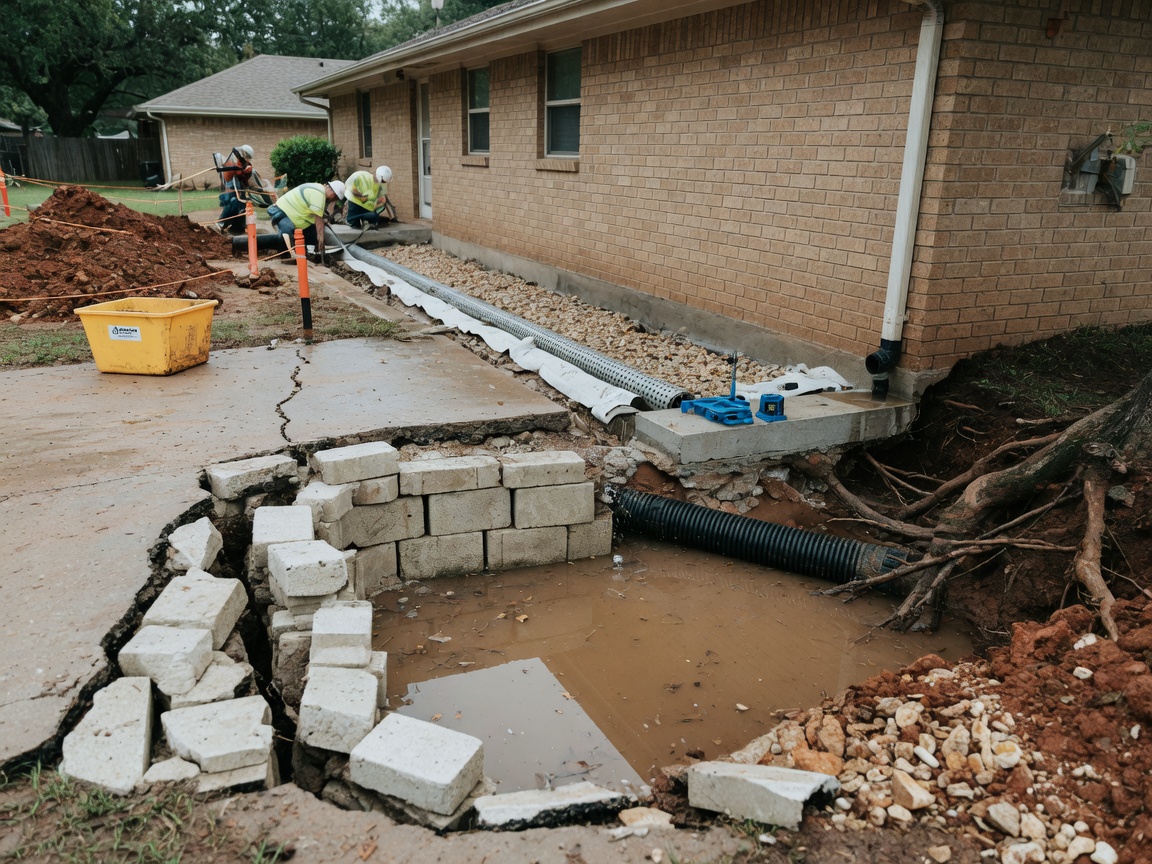
When people picture foundation problems, they usually picture something dramatic: a huge crack, a sinking corner, a house tilting. But most of the time the real cause is something much more ordinary, and it is sitting right outside your door.
It is water. Where it goes, how fast it gets there, and how much of it sits against your foundation. In our experience, fixing the water problem is often the difference between a repair that lasts and one that has to be done again in a few years. Here is how it works, how to check your own place, and what the fixes look like.
Why water matters so much
A lot of Texas homes sit on clay soil that swells when it is wet and shrinks when it dries. Your foundation moves with the soil under it. That means anything that changes how wet the soil is, especially if it changes it unevenly, can make the foundation move unevenly.
Picture one side of your house where a downspout empties every time it rains. That soil stays wet and soft. The other side is dry and sunny and bakes hard. Over time, one side of the foundation can lose support while the other holds up, and that uneven movement cracks things.
The most common drainage problems
- Downspouts that dump at the base of the wall. All the water coming off the roof lands in one spot, right next to your foundation.
- Clogged or broken gutters. Water overflows at the edge and pours down the wall.
- Soil that slopes toward the house. Over the years, soil settles, mulch builds up, and the ground can end up tilting toward the foundation instead of away.
- Low spots near the house. Puddles that sit for a day or more are a sign the ground is not draining.
- Plumbing leaks. A slow leak under or near the slab can wash out soil or keep it soaked, and you may not see it.
- Big trees close to the house. Roots pull moisture out of the soil, especially in dry weather, so the soil on that side can shrink.
- Bare soil on one side. Soil with no cover or shade dries out faster than the rest.
How to check your own yard
You can do a good first check in about 20 minutes, ideally during or just after a rain:
- Watch where water goes. Stand outside during a rain, if you can. Where do the downspouts empty? Does water run toward the house or away from it?
- Check the gutters. Are they clean? Are they overflowing or pulling away from the roof edge?
- Check the slope. The ground should drop away from the foundation, about an inch per foot for the first several feet if possible. If you have flower beds or mulch built up against the wall, that can block drainage.
- Look for puddles. If water is still standing near the house a day later, that spot is a problem.
- Look at the trees. Large trees within about 20 feet of the house are worth keeping an eye on during dry weather.
- Look at the water bill. A jump you cannot explain can point to a leak.
Take photos and notes as you go. If you are also seeing cracks or sticking doors, our guide to spotting foundation cracks after heavy rain can help you put the whole picture together.
What the fixes look like
Not every drainage problem needs digging. Most are fixed in the simplest way that works. Here is how we think about it:
- Extend or reroute downspouts. Often the cheapest, easiest fix. Downspout extensions or underground lines carry roof water well away from the foundation.
- Clean or repair gutters. Gutters that work keep water off the wall and out of the soil next to it.
- Regrade the soil. Adding soil near the foundation so the ground slopes away from the house sends water in the right direction. This often does a lot.
- Surface drains. For low spots where water collects, a drain can give it somewhere to go.
- French drains. A perforated pipe in a gravel-filled trench collects water and carries it away. A French drain is useful when water has nowhere to drain on its own, like a low area or a spot where water flows toward the house.
- Fix the leak. If there is a plumbing leak, that has to be repaired, or nothing else will hold.
You can read more about how we approach this on our foundation drainage page.
Drainage alone will not fix a foundation that has already moved
This is important. Fixing drainage stops a common cause of movement. It does not lift a foundation that has already settled. If your house has dropped, you may need both: repair work to stabilize and lift it, and drainage work to keep it from happening again.
Depending on what is going on, that repair might be slab foundation repair, foundation settlement repair, foundation pier installation or house leveling. If you have a crawl space, the moisture issues may also involve crawl space repair.
How drainage connects to the weather
Water problems and weather problems are tied together. A long dry spell shrinks the soil and pulls it away from the foundation. Then a heavy rain pours water into those gaps, which can wash soil out and make the next dry spell worse. We explain this cycle in our guide on how clay soil affects your foundation during dry spells.
What it might cost
Drainage work can range from very cheap to more involved. National estimates put a French drain at roughly $20 to $60 per linear foot, and regrading or gutter work can run from a few hundred dollars into the thousands depending on the size of the project. Those are national ballpark figures, not a quote. For what drives the price of foundation work, see our guide on what influences foundation repair pricing, or call us for exact numbers for your home.
When to call someone
Reach out if you have standing water near the house that does not go away, if water is coming in through cracks or at the slab edge, if gutters and downspouts are not solving the problem, or if you are seeing cracks, sticking doors or sloping floors along with drainage issues.
A foundation inspection is a good place to start. We look at the foundation and the drainage together, so you get one clear picture of what is happening and what to do about it.
Where we work
We help homeowners across Texas, including Austin, Dallas, Houston, San Antonio, Frisco and Richardson. See all our service areas on our cities we serve page, or read about our overall foundation repair services.
The short version
Water is behind most foundation problems. Check your gutters, downspouts, grading, low spots and trees, fix the simple things first, and do not skip drainage when a foundation has been repaired. If something keeps changing or keeps coming back, get it looked at.
If you want help figuring out where your water is going, call us Monday through Friday, 8am to 6pm. We will talk through what you are seeing and set up an inspection if it makes sense.