
2026-06-12 · Joe Root
Step-By-Step Guide to Spotting Foundation Cracks After Heavy Rain
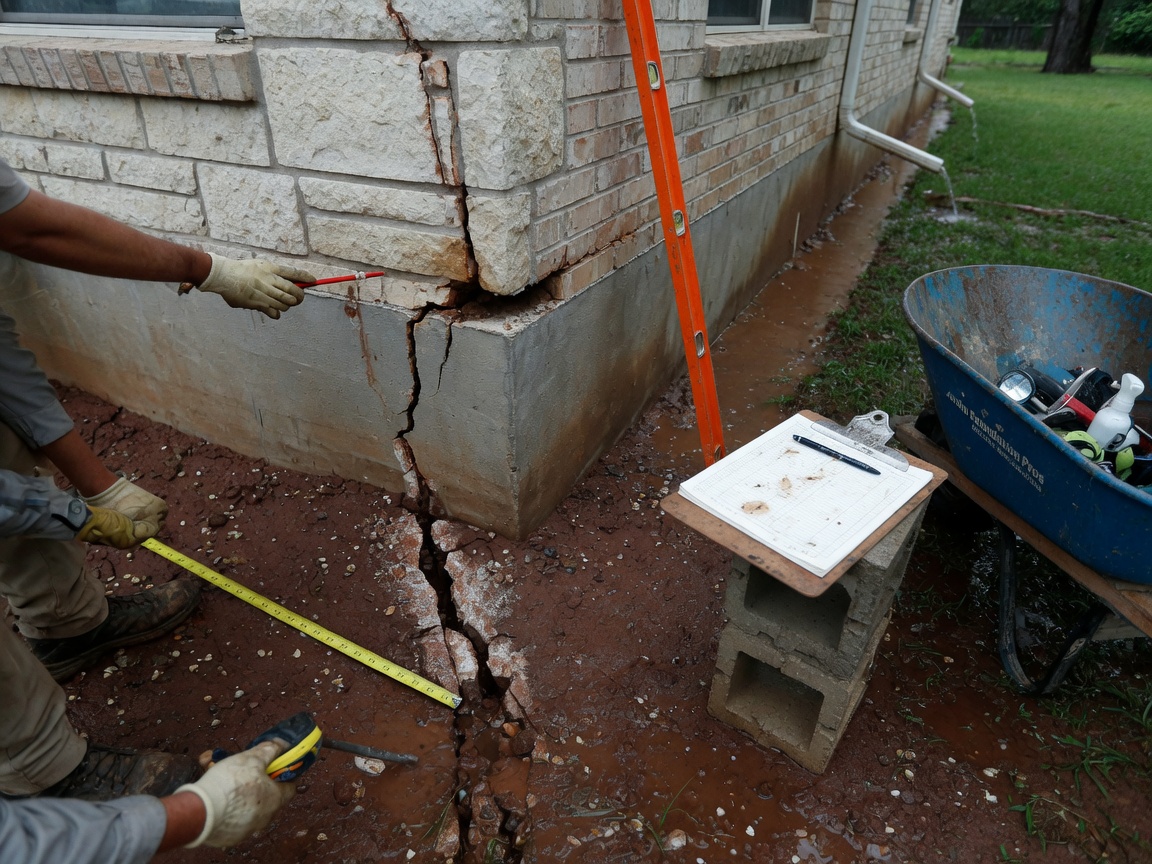
After a big storm, a lot of homeowners start wondering whether that crack in the garage was always there. Maybe a door is sticking, or you noticed a new line in the drywall and now you cannot stop seeing it.
The good news is that you do not need any special tools to do a first check. You need about 30 minutes, your phone, and a tape measure. This guide walks you through it in the order we would do it, and tells you what is usually nothing and what is worth getting looked at.
Before you start
Wait until the rain has stopped and the ground has had a day or two to settle. Soil that is still saturated can look worse than it is, and some movement shows up a day or two after the storm rather than during it.
Grab your phone for photos, a tape measure or ruler, and a pen. A small notebook helps too. Write the date on everything, because the most useful question later will be "has it changed?"
Step 1: Walk the outside of the house
Start at the front and walk slowly around the house, staying close to the foundation. You are looking for:
- Cracks in the foundation or slab edge. Look at the concrete and at the brick. Hairline cracks are very common. What you do not want to see is a crack that is wide, or one where one side has shifted so it sticks out past the other.
- Stair-step cracks in brick. A crack that follows the mortar joints up and over in a staircase pattern is a classic sign of movement.
- A gap between the soil and the foundation. If the soil has pulled away or washed out, water now has a direct path to the edge of your slab.
- Standing water or soft ground. Look for puddles within a few feet of the house. Water that sits there for a day or more is not draining correctly.
- Where your downspouts empty. If water dumps right at the base of the wall, it is soaking the same spot every time it rains.
Photograph anything you notice and put a ruler or coin in the picture so the size is clear.
Step 2: Check inside the house
Now go inside. The inside of the house often tells you more than the outside:
- Doors and windows. Open and close each one. Do any stick, rub, or no longer latch? Do any have an uneven gap along the top?
- Gaps at trim. Look where the baseboards meet the floor and where the walls meet the ceiling.
- Drywall cracks. Look especially above doors and windows, where cracks tend to run diagonally out from the corners.
- Floors. Walk through each room. Do any feel sloped, bouncy or soft? Do you see tile cracks or lifted corners?
- Garage. Look at the floor, and at the joint where it meets the wall.
A quick check for slope: roll a marble or a ball on a hard floor. It is not scientific, but if it keeps heading the same way across several rooms, note it down.
Step 3: Measure what you find
Not every crack matters. Here is a rough guide:
- Hairline (thinner than a credit card, about 1/16 inch): Very common, especially in newer concrete. Usually cosmetic, but keep an eye on it.
- Around 1/8 inch: Worth tracking. Mark the ends of the crack with a pencil and date it so you can see whether it grows.
- 1/4 inch or wider, or one side higher than the other: Do not ignore this one. Have it looked at.
- Stair-step brick cracks, or diagonal cracks from corners of openings: These deserve a closer look even when they are narrow.
Step 4: Look at the water
Water is behind most of what we see. Walk the yard and check:
- Are the gutters clean, and are they overflowing at the edges?
- Do the downspout extensions carry water several feet from the house?
- Does the ground slope away from the foundation, or does it tilt toward it?
- Are there low spots near the house where water collects?
If the answer to any of these is "not great," that is useful information. Even if the foundation turns out to be fine, fixing it now helps protect it. We cover that on our foundation drainage page.
What is probably normal
Many things that look scary are not a big deal. Hairline cracks in new concrete, a thin crack where a patch meets older material, and small seasonal cracks that open and close with the weather are all common. Cosmetic cracks in drywall around a door that has had a rough winter are also common.
The thing that changes the picture is movement. A crack that is growing, a door that is getting harder to close each month, or several signs showing up together is a different story.
What not to do
- Do not just patch and forget. Filling a crack hides it, but if the foundation is still moving, it will reopen.
- Do not panic and call for the biggest fix. Many problems come down to drainage or minor settlement. Get an opinion before you commit to anything big.
- Do not ignore it for years. The earlier we see it, the easier and cheaper it tends to be to fix.
When to call someone
Get in touch if you notice cracks wider than 1/4 inch, cracks that keep growing, stair-step cracks in brick, doors and windows that keep getting harder to operate, floors that are noticeably out of level, or any crack that lets water in.
The easiest place to start is a foundation inspection. We look at the cracks, measure floor elevations and check the drainage, then explain what we found in plain language. If the cracks themselves need attention, our foundation crack repair page explains how we seal and reinforce them. If the cracks are a sign of the foundation moving, the fix may involve slab foundation repair or foundation settlement repair.
If you are curious about why rain seems to cause problems at all, we wrote a guide on how clay soil affects your foundation during dry spells. It explains why a dry summer followed by a big storm is often when problems show up. And if you are wondering what repairs can cost, see what influences foundation repair pricing.
Where we help
We work with homeowners across Texas, including Austin, Dallas, Houston, San Antonio, Frisco and Richardson. You can see the full list on our cities we serve page, or learn more about our overall foundation repair services.
The short version
Walk the outside, check the inside, measure what you find, look at where the water goes, and write the date on everything. Most cracks are not an emergency, but cracks that grow or show up with sticking doors and sloped floors are worth a call.
If you would like us to take a look, call us Monday through Friday, 8am to 6pm. We are happy to talk through what you found before anyone comes out.