
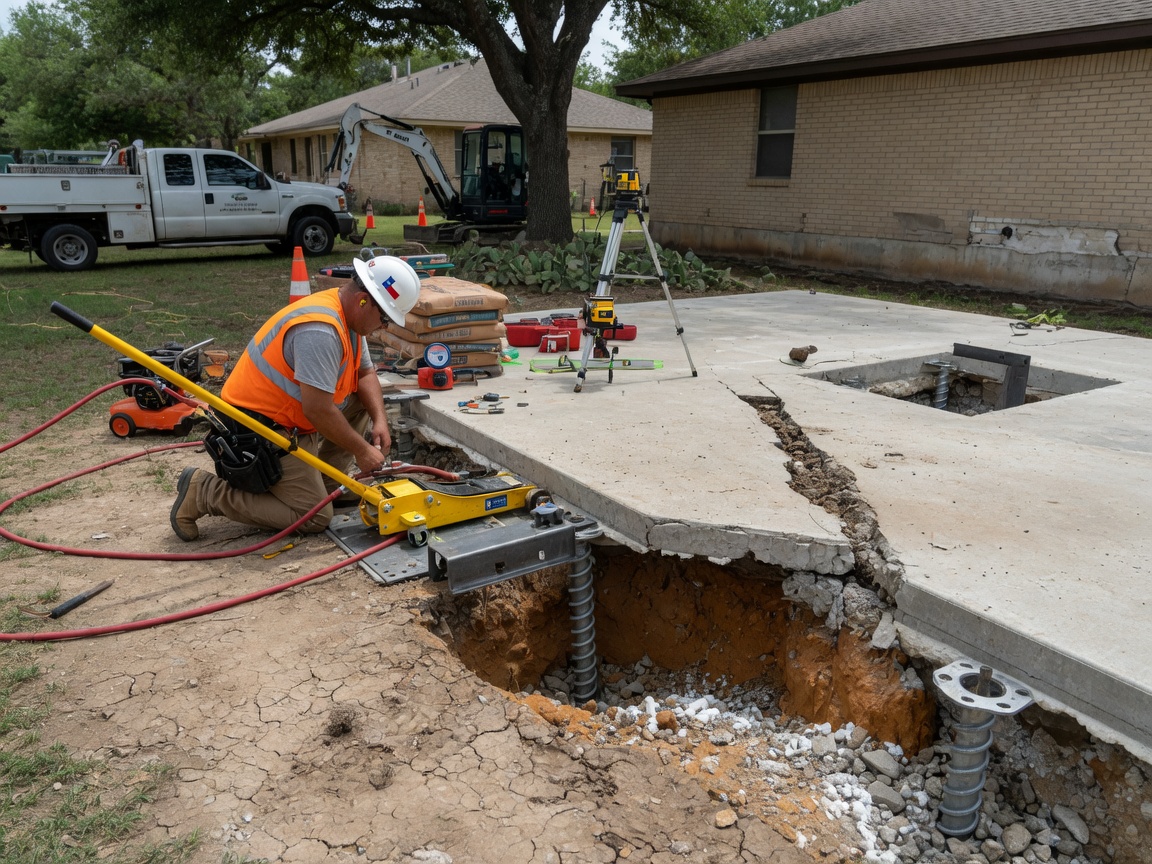
Slab Foundation Problems in Texas
Most Texas homes built since the 1970s sit on a concrete slab over expansive clay. The clay swells after heavy rain and shrinks during long dry spells, so parts of the slab can rise or drop unevenly. Over time that shows up as cracks in the slab or brick, doors and windows that stick, and floors that slope.
Slab Foundation Repair Near You — Choose Your City
Every city below has its own local Slab Foundation Repair page with coverage details.
Harris
Dallas
Collin
Hidalgo
Tarrant
Fort Bend
Denton
Galveston
Brazoria
Williamson
Hays
Dallas County
Travis
El Paso
Bexar
Cameron
Comal
Johnson
Brazos
Webb
Harris County
Travis County
Hidalgo County
Kaufman County
Williamson County
Tarrant County
Maverick County
Cameron County
Bell
Guadalupe
Lubbock
In parts of Central Texas, shallow limestone can make the ground under one part of a slab behave very differently from another. Large trees, plumbing leaks and poor drainage near the slab edge add to the movement.
How We Repair a Slab Foundation
We start with elevation readings and a look at cracks, grading, gutters and moisture around the home. Depending on what we find, the repair may use piers to stabilize settled areas, slab lifting to bring low sections back up, crack repair, and drainage correction so the same water problem does not cause new movement.
You get a written scope and an upfront quote before work begins. We serve homeowners in cities across Texas.
Related Services
Slab problems often go together with other issues. See foundation crack repair, foundation settlement repair, foundation pier installation and foundation drainage, or start with a foundation inspection. For an overview, see our main foundation repair page.
Technician insight
A slab that keeps moving after a repair usually points to a moisture problem nearby, such as a leaking line, a downspout dumping at the corner or bare soil that bakes in summer. We look for that cause before deciding how many piers are needed.
A Typical Slab Settlement
A common case is a slab home where one corner has dropped after a dry summer, leaving a stair-step brick crack and a door that no longer latches. The usual path is elevation readings, piers at the settled corner, and a gutter and grading fix on that side of the house.
Slab Foundation Repair Services We Offer in Texas
✓Pier Stabilization
Steel piers placed under settled sections of the slab to carry the load on stable soil.
✓Slab Lifting and Leveling
Foam or grout injection to raise low sections of a slab and fill voids.
✓Slab Crack Repair
Epoxy or polyurethane injection and reinforcement of structural cracks.
✓Drainage Correction
Grading, gutter and French drain work to keep water away from the slab edge.
Slab Foundation Repair Cost in TX
| Service | Typical Range | What Affects It |
|---|---|---|
| Pier installation (per pier) | $1,000–$3,000 | National estimate; varies with depth and access. |
| Slab lifting (foam or mudjacking) | $500–$3,000 | National estimate; depends on area lifted. |
| Slab crack repair | $300–$1,000 | National estimate; depends on crack length. |
| Drainage correction | $1,000–$5,000 | National estimate; regrading and French drain. |
Ranges are national estimates. Call (214) 807-4840 for exact pricing for your home and location.
How it works
- 1
Inspection and Elevation Readings
We check cracks, door and window operation and floor elevations to map where the slab has moved.
- 2
Soil and Drainage Review
We look at grading, gutters, trees and moisture around the foundation to find what is driving the movement.
- 3
Written Scope and Quote
You receive the proposed repair, the number and location of piers or lift areas, and the price before any work starts.
- 4
Repair and Final Check
We complete the work, re-check elevations and walk you through the finished repair.
Pricing
National average estimates are shown for reference. Call us for exact pricing for your home and location.