
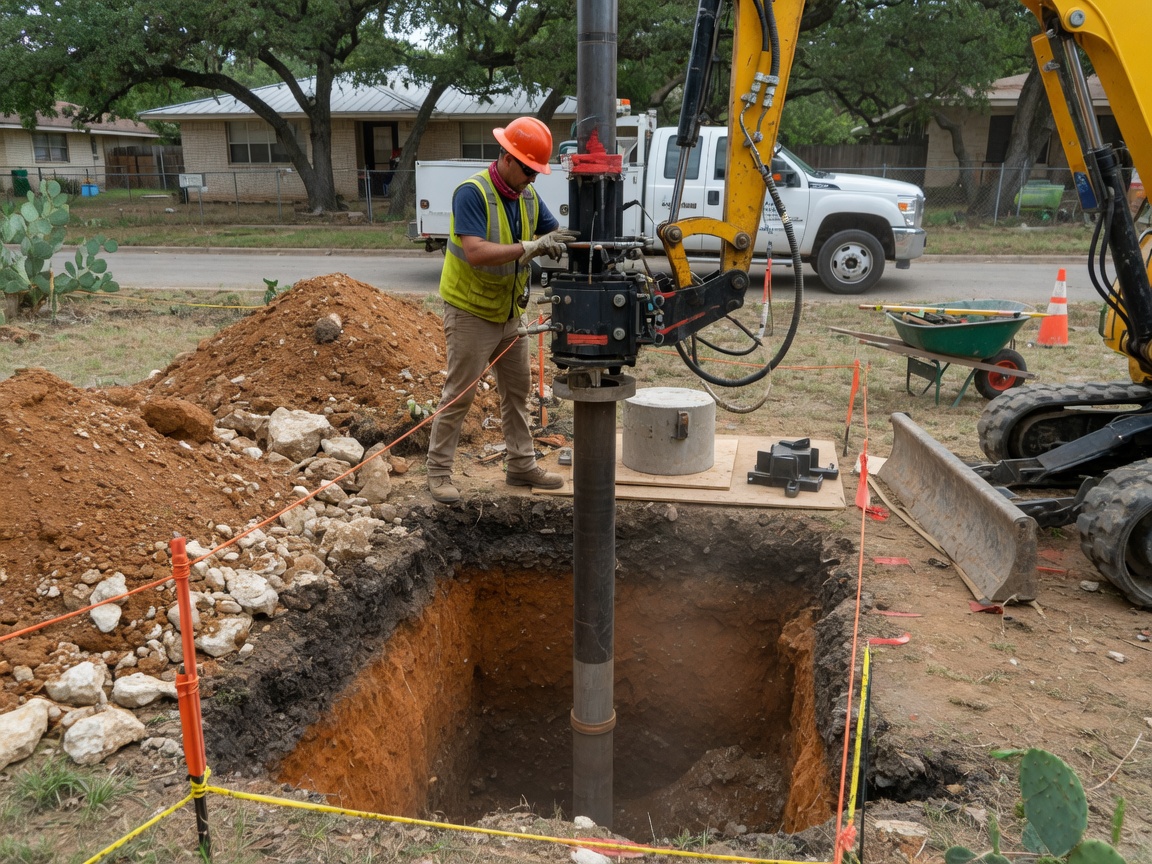
Choosing the Right Foundation Pier
Piers carry a foundation's weight down to soil or rock that does not move with the weather. The right type depends on the structure, soil and access. Push piers are steel pipes driven to a stable layer using the weight of the structure. Helical piers are steel shafts with screw plates that are turned into the ground and measured by installation torque. Concrete piers are cast or pressed concrete cylinders, often used for pier-and-beam and slab repairs.
How Pier Installation Works
We start with elevation readings and a plan for pier locations. Access holes are dug at the foundation edge, piers are installed to the required depth and load, and brackets transfer the foundation's weight onto them. Where lifting is possible, we raise the foundation in small steps and then lock it off. We backfill, clean up and re-check elevations.
You receive a written scope and upfront quote before work begins. We also review drainage so the soil around the piers does not keep changing.
Related Services
Piers are used in foundation settlement repair, slab foundation repair, pier and beam foundation repair and house leveling. Not sure how many piers you need? Start with a foundation inspection, or see our main foundation repair page.
Technician insight
More piers is not always better. What matters is placing them where the foundation has lost support and taking them to ground that will not move, which is why we measure and plan before we dig.
A Typical Pier Installation
A common case is a slab home with one settled wall. The usual path is a row of piers along that wall, lifting the slab in small steps, locking it off and correcting the drainage on that side.
Foundation Pier Installation Services We Offer in Texas
✓Helical Piers
Screw-in steel piers installed to a measured torque for reliable load capacity.
✓Push Piers
Steel piers hydraulically driven to a stable layer under the foundation edge.
✓Concrete Piers
Cast or pressed concrete piers for slab and raised foundation support.
✓Pier Brackets and Load Transfer
Brackets that connect the foundation to the piers and hold the lifted position.
Foundation Pier Installation Cost in TX
| Service | Typical Range | What Affects It |
|---|---|---|
| Concrete pier (each) | $1,000–$2,500 | National estimate; depends on depth. |
| Helical pier (each) | $1,500–$3,500 | National estimate; depends on depth and torque. |
| Push pier (each) | $1,000–$3,000 | National estimate; depends on access. |
| Full perimeter stabilization | $5,000–$20,000 | National estimate; depends on home size and pier count. |
Ranges are national estimates. Call (214) 807-4840 for exact pricing for your home and location.
How it works
- 1
Survey and Layout
We measure elevations and mark pier locations along the areas that have settled.
- 2
Excavation and Installation
We dig access points and install piers to the required depth and load.
- 3
Lift and Lock-Off
We raise the foundation in small steps where possible and lock it onto the piers.
- 4
Backfill and Review
We backfill, clean up and re-check elevations with you.
Pricing
National average estimates are shown for reference. Call us for exact pricing for your home and location.