
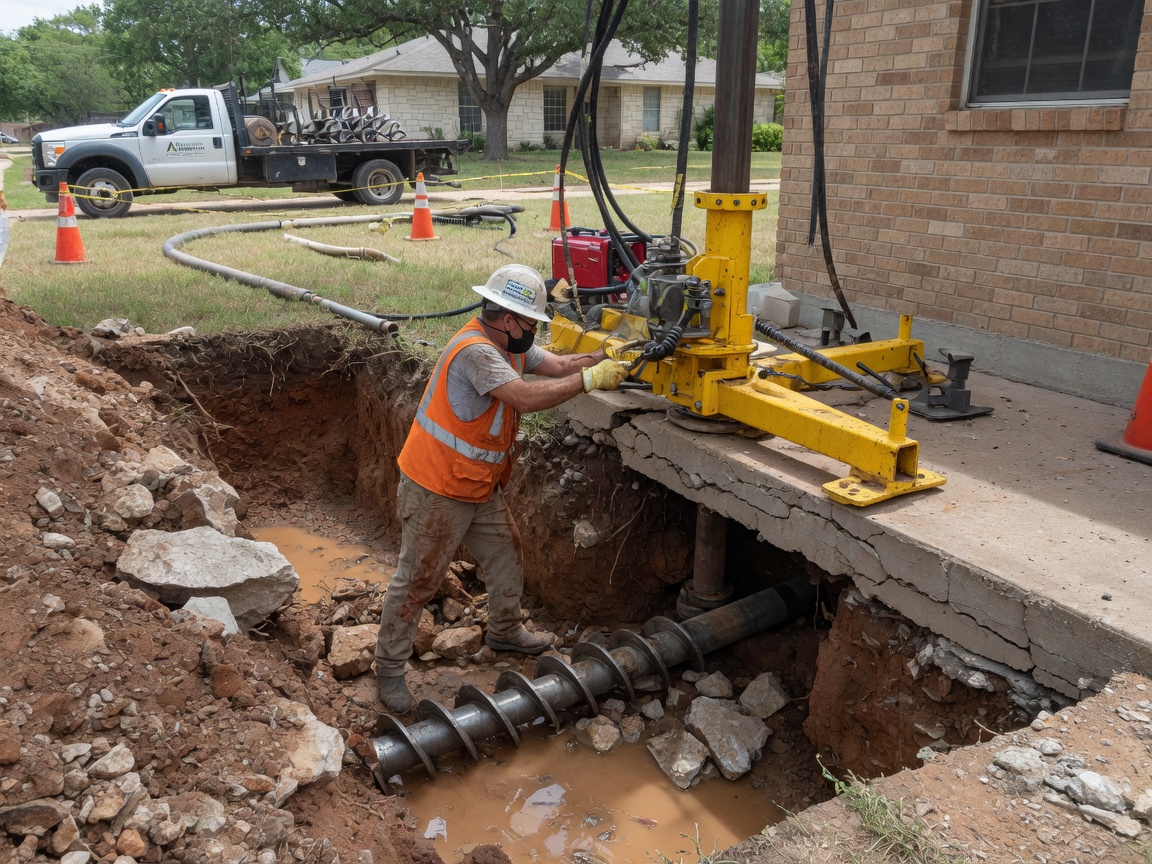
Austin's black clay soils expand and contract sharply with the region's hot humid summers and occasional heavy spring rains, pulling slab edges downward in older neighborhoods such as Hyde Park, Clarksville, and Travis Heights. Homes built before the 1980s on shallow footings often show interior cracks and sticking doors first along the south and west walls where afternoon sun dries the soil fastest. Technicians typically install steel piers or helical anchors to reach stable strata below the active zone rather than attempting surface patches that fail within one or two wet-dry cycles.
Edge cases appear near Lady Bird Lake and Barton Creek where poor drainage from upslope lots saturates fill material under slabs, accelerating settlement in Zilker and Barton Hills. Crews must sometimes reroute downspouts and add French drains before underpinning to prevent water from undermining new piers. In Travis County, any work that alters grading near the 100-year floodplain requires a simple permit review, so crews photograph existing contours and note elevations before starting.
Materials include 3-inch and 4-inch galvanized pipe piers driven to refusal, hydraulic jacks rated for 50-ton loads, and non-shrink grout for void filling. Homeowners in Mueller or Westlake often request epoxy crack injection alongside piers when hairline fissures threaten plumbing embedded in the slab. Skipping the drainage step is the most common reason repairs reopen after the next heavy rain.
Technician insight
In Austin the thing that catches most people out with sinking foundation repair is the black clay under older Hyde Park and Clarksville homes that keeps moving for months after a dry spell; if you skip the drainage fix and just install piers the slab will settle again the next time Barton Creek floods the back yards.
Settled Slab in East Austin Bungalow
A 1960s bungalow near East Austin showed a 3-inch drop along the rear wall after two wet winters. Soil probes found saturated fill under the slab edge. Crews installed four helical piers to refusal, added a short French drain, and injected grout to fill the void. Floors leveled within 1/4 inch and no new cracks appeared after the following spring rains.
Sinking Foundation Repair Services We Offer
✓Helical Pier Installation
Steel helical piers are driven to bedrock to stop and reverse slab settlement common on Austin's expansive clays.
✓Slab Jacking and Leveling
Polyurethane or cementitious grout is injected beneath settled slabs to lift and stabilize floors in neighborhoods like East Austin.
✓Drainage Correction for Foundations
French drains and regraded swales redirect runoff away from foundations to reduce moisture-driven sinking around Lady Bird Lake properties.
✓Underpinning for Settled Slabs
Push piers or helical anchors are placed under perimeter beams to support older homes in Hyde Park and Clarksville showing differential settlement.
✓Crack Sealing and Void Filling
Epoxy or polyurethane seals slab cracks while grout fills voids created by soil shrinkage in South Congress and Zilker homes.
Sinking Foundation Repair Cost in TX
| Service | Typical Range | What Affects It |
|---|---|---|
| Initial Inspection and Report | Free–$250 | Waived when repair proceeds; full report includes elevation map and soil notes. |
| Helical Pier Installation | $1,200–$3,500 | Per pier; price rises with depth required in deeper clay zones near Mount Bonnell. |
| Drainage Correction | $800–$2,800 | French drain length and access around existing landscaping affect cost. |
| Slab Jacking | $1,500–$4,000 | Depends on square footage lifted and material chosen. |
Ranges are typical for TX and confirmed with an exact written quote before any work starts.
How it works
- 1
Site Assessment and Soil Evaluation
Technicians inspect interior and exterior cracks, measure floor slopes, and probe soil moisture around the perimeter in Travis County homes.
- 2
Engineering and Permit Coordination
Load calculations determine pier depth and spacing; simple grading permits are filed when drainage work affects lots near Lady Bird Lake.
- 3
Pier Installation and Leveling
Hydraulic equipment drives piers to refusal then lifts the slab in small increments while monitoring for new stress points.
- 4
Drainage Improvements and Backfill
French drains or swales are added, soil is compacted, and the site is restored to original grade before final inspection.
Pricing
Upfront written quotes after on-site inspection; final price depends on soil depth, number of piers, and drainage needs.