
Austin's hot humid summers and occasional heavy spring rains drive soil movement that affects older slab homes in Hyde Park and Clarksville. Push piers reach stable strata below the active clay layer common across Travis County. Crews must account for the variable fill depths left from original construction in areas near the University of Texas Tower and Lady Bird Lake where older homes sit on mixed soils.
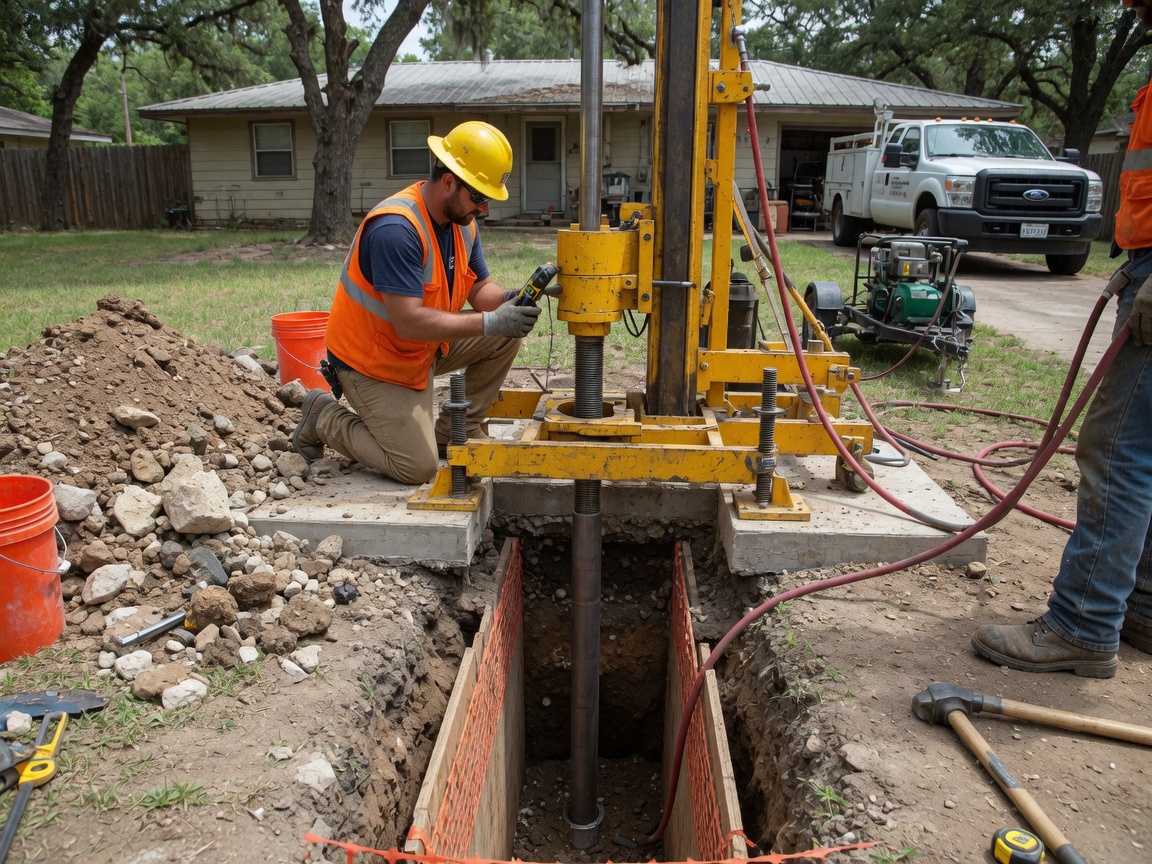
Installation begins with small excavations at each pier location to avoid damaging existing plumbing common in 1950s-1970s homes in Zilker and Mueller. Hydraulic equipment drives steel piers until refusal at load-bearing depth. In Westlake and Barton Hills the process often requires longer piers due to deeper topsoil over limestone, while East Austin lots near Lady Bird Lake can hit groundwater sooner and demand dewatering steps.
Code compliance in Austin requires permits when piers alter load paths on residential slabs. Technicians verify each pier's final drive pressure on site and document depths for the homeowner. Work in neighborhoods like South Congress or Travis Heights frequently involves tight access between mature trees and fences, requiring hand excavation rather than machinery to protect root systems and adjacent structures.
Nearby cities such as Round Rock, Pflugerville, and Cedar Park share similar clay conditions but often feature newer slabs with different reinforcement patterns. Push pier crews adjust spacing and bracket styles accordingly when extending service outside central Austin.
Technician insight
In Austin, the thing that catches most people out with Push Pier Installation is how quickly groundwater appears in East Austin lots near Lady Bird Lake versus the deeper limestone refusal found in Westlake. Homeowners often underestimate the extra dewatering time or longer piers required on their specific block.
Settlement repair on a 1960s slab in Zilker
A homeowner noticed widening cracks along the south wall after two wet springs. Inspection showed the slab had dropped three-quarters of an inch where fill soils had consolidated. Crews installed six push piers from the exterior, reaching refusal at twelve to fifteen feet, then transferred load through new brackets. The cracks closed and the floor felt level again within the same week.
Push Pier Installation Services We Offer
✓Residential Slab Pier Installation
Drive steel push piers beneath single-family slabs in Hyde Park and Clarksville to stop ongoing settlement caused by seasonal moisture changes.
✓Commercial Foundation Piering
Install push piers under small commercial buildings in East Austin and Mueller where parking lot drainage accelerates soil movement beneath slabs.
✓Interior Slab Stabilization
Place piers from inside finished spaces in Travis Heights homes when exterior access is blocked by landscaping or neighboring structures.
✓Exterior Perimeter Piering
Drive piers along the outside edge of slabs in Zilker and Barton Hills to address edge settlement common after heavy spring rains.
✓Pier Bracket Retrofit
Replace or upgrade existing pier brackets on older installations in Westlake when original hardware shows corrosion from Austin's humid summers.
Push Pier Installation Cost in TX
| Service | Typical Range | What Affects It |
|---|---|---|
| Single-family slab push pier job | $3,800–$9,500 | Depends on pier count and depth needed in clay soils |
| Interior access pier installation | $4,500–$11,000 | Higher when hand digging is required inside finished spaces |
| Perimeter pier addition | $2,200–$4,800 | Varies with exterior obstructions in older neighborhoods |
Ranges are typical for TX and confirmed with an exact written quote before any work starts.
How it works
- 1
Site Assessment
Technicians examine crack patterns and elevation readings across the slab, noting soil conditions typical for the specific Austin neighborhood.
- 2
Excavation and Layout
Small pits are dug at planned pier locations while protecting plumbing lines common in older Travis County homes.
- 3
Pier Driving
Hydraulic rams push steel sections to refusal, recording final pressure and depth for each location.
- 4
Bracket Attachment and Load Transfer
Steel brackets are secured to the slab edge and the structure is lifted slightly to transfer weight onto the new piers.
- 5
Backfill and Cleanup
Excavations are refilled and the site is restored, with final documentation provided to the homeowner.
Pricing
Pricing varies by number of piers, access difficulty, and soil depth required in each Austin neighborhood.