
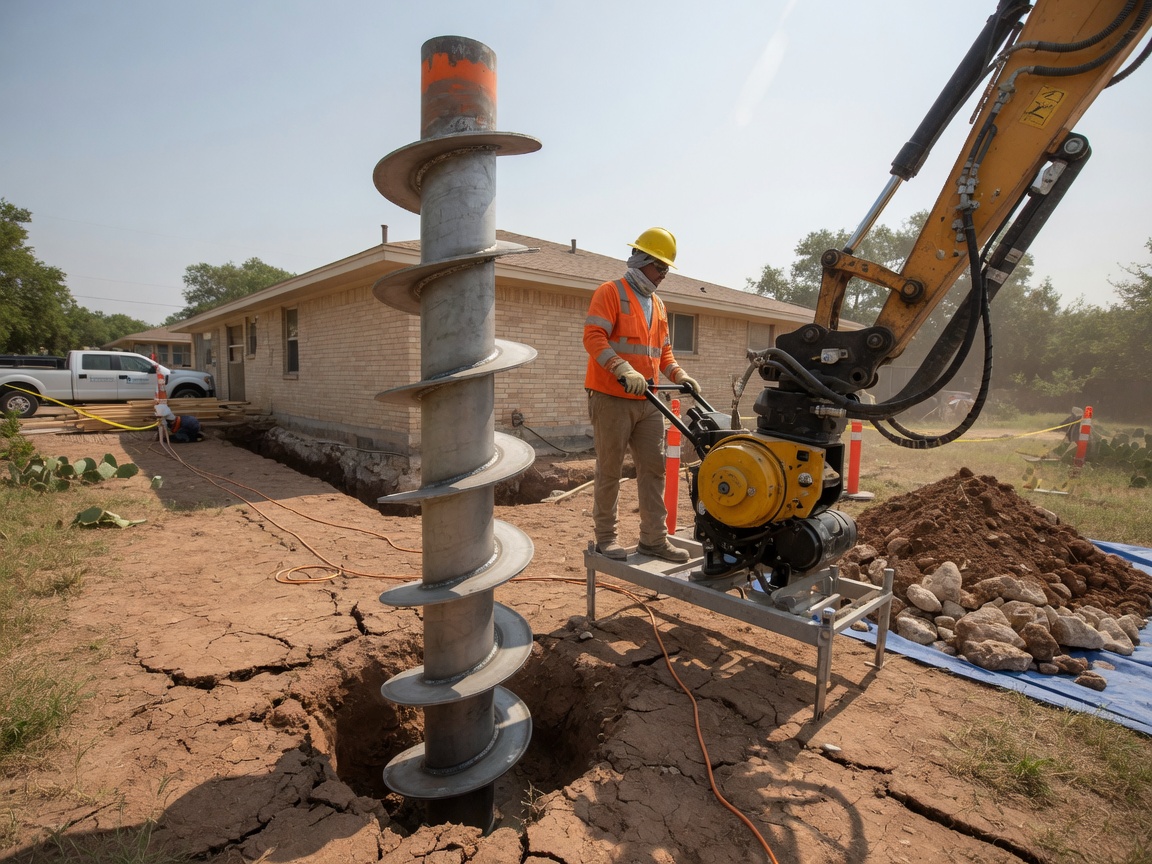
Austin's hot humid summers and mild winters drive repeated soil moisture cycles that swell and shrink the clay common throughout Travis County. Helical piers transfer loads to stable strata below the active zone, which often sits 8 to 15 feet deep near Lady Bird Lake and in Barton Hills. Older homes in Hyde Park and Clarksville frequently rest on shallow footings that move when moisture changes, while newer slabs in Mueller and East Austin can still settle if fill was poorly compacted. Steel helical piers resist corrosion in the region's variable groundwater and allow installation with minimal vibration, protecting nearby structures along South Congress or near the Texas State Capitol.
Edge cases appear when piers must reach past undocumented utilities or when torque values spike in dense gravel lenses common west of Mopac. In these situations crews switch to smaller-diameter helices or add extensions rather than forcing equipment. Code compliance in Austin requires engineering letters for any pier work that affects load paths, and inspectors often request torque logs plus depth records before final sign-off. Homeowners in Westlake or Zilker sometimes discover that tree roots from mature live oaks interfere with pier placement, requiring hand digging or angled leads to maintain proper spacing.
Round Rock and Pflugerville properties on the northern edge of the metro often sit on slightly different soil profiles than central Austin, so pier length and helix count are adjusted after on-site torque testing. Installation crews based at 9600 N Mopac Expy keep standard weekday hours of 8am to 6pm and Saturday mornings to accommodate access in dense neighborhoods like Travis Heights without disrupting traffic.
Technician insight
In Austin the thing that catches most people out with Helical Pier Installation is how quickly torque readings change once you move from the shallow fill around older Hyde Park homes into the native clays that extend toward Lady Bird Lake; skipping the extra probe holes often leads to piers stopping short and the slab settling again after the next wet spring.
Settling Slab in Hyde Park Bungalow
A 1940s bungalow near 45th Street showed widening cracks along the rear wall after two wet winters. Torque probes revealed the active clay zone reached 11 feet. Helical piers were installed to 14 feet with 10-inch helices, brackets attached under the perimeter beam, and loads transferred. Floor movement stopped and the homeowner could finish interior repairs without further shifting.
Helical Pier Installation Services We Offer
✓Residential Helical Pier Installation
Steel helical piers are driven beneath single-family homes in Hyde Park and Clarksville to stop ongoing settlement caused by seasonal clay movement.
✓Slab Pier Installation for Settling Floors
Targeted helical piers are placed under interior slabs in East Austin and Mueller to lift and stabilize floors without major interior demolition.
✓Helical Piers near Waterways
Corrosion-resistant piers are installed for homes in Zilker and Barton Hills where high groundwater near Lady Bird Lake accelerates soil movement.
✓Commercial Helical Pier Systems
Larger-diameter helices support light commercial structures in Downtown and along South Congress where vibration limits rule out driven piles.
✓Helical Pier Repair for Pool Decks
Small-diameter piers stabilize settling pool decks and patios around Barton Springs Pool and Zilker Park where irrigation and runoff create localized settlement.
Helical Pier Installation Cost in TX
| Service | Typical Range | What Affects It |
|---|---|---|
| Single-family home pier set | $4,500–$9,500 | Varies with pier count and depth needed in Hyde Park or Travis Heights clay |
| Interior slab stabilization | $2,800–$6,200 | Fewer piers but more access labor in East Austin or Mueller homes |
| Pool deck or patio piers | $1,800–$3,400 | Smaller helices and limited equipment in Zilker or Barton Hills |
| Engineering and permit package | $650–$1,100 | Required for most Travis County jobs |
Ranges are typical for TX and confirmed with an exact written quote before any work starts.
How it works
- 1
Site Evaluation And Soil Testing
Technicians review foundation movement patterns, then perform torque probe tests at multiple locations to determine required pier depth and helix size for the specific clay profile.
- 2
Engineering And Permit Coordination
Stamped plans are prepared for Travis County review, including load calculations and placement diagrams that satisfy Austin building department requirements before work begins.
- 3
Pier Installation
Hydraulic equipment installs each helical pier to the engineered torque and depth, with extensions added as needed to reach stable soil below the active clay zone.
- 4
Load Transfer And Documentation
Foundation brackets are attached and loads are transferred; final torque logs and depth records are supplied for the homeowner and city inspector.
Pricing
Cost depends on number of piers, required depth in local clay, and access constraints typical of older Austin lots.