
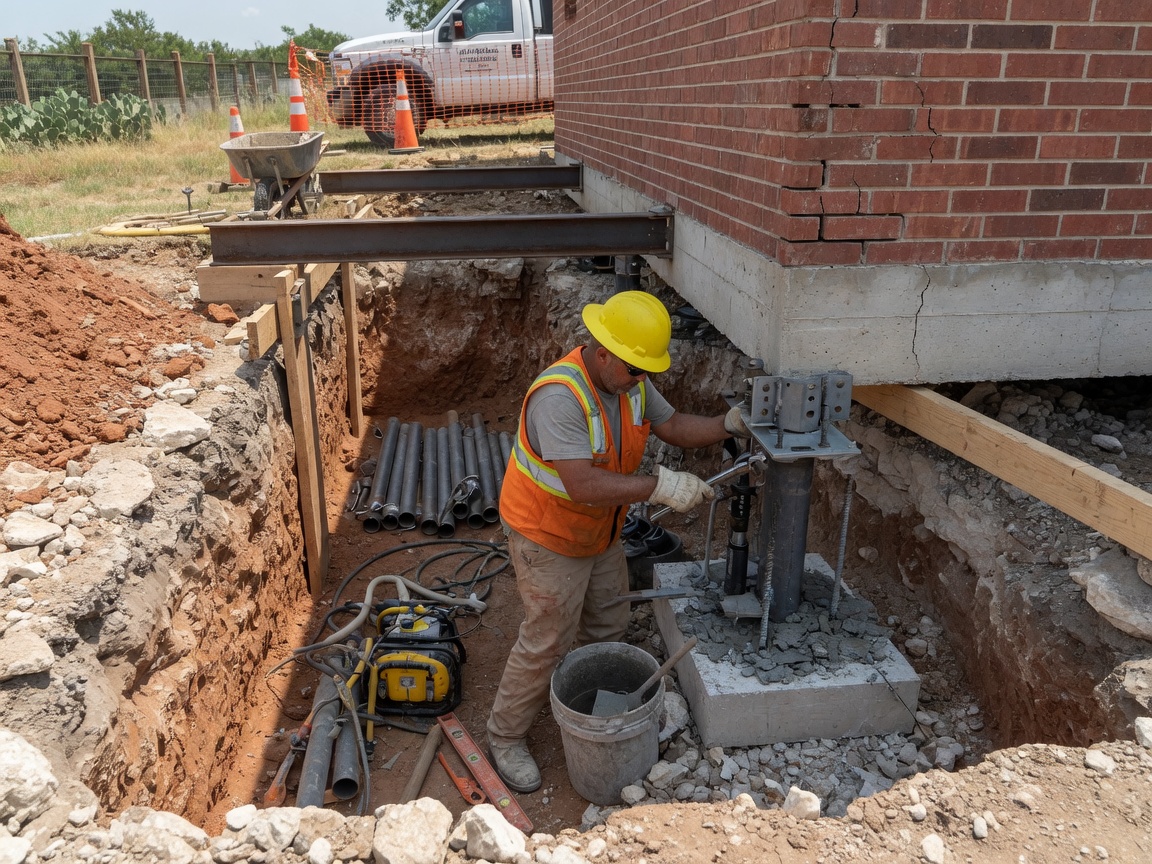
Austin sits on expansive clay soils that swell and shrink with the area's hot humid summers and occasional heavy rains, stressing foundations in older neighborhoods like Clarksville and Hyde Park where many homes date to the early 1900s with pier-and-beam construction. Underpinning transfers loads to stable strata below the active zone, often using steel piers or helical anchors driven past the 8-12 foot depth where moisture fluctuations stop. Crews must account for the mild winters that keep soils from freezing but allow year-round root growth near Lady Bird Lake and Barton Creek that can displace footings.
In Travis County, underpinning jobs frequently involve coordinating with city permitting for work near the Edwards Aquifer recharge zone, especially in South Congress and East Austin where older slabs sit on fill material prone to differential settlement. Technicians evaluate soil borings and monitor for the spring wildflower season when saturated ground after rains accelerates movement. Edge cases include properties on sloped lots in Westlake or Zilker where lateral soil pressure requires additional bracing before piers are installed.
Homeowners in Mueller or Barton Hills often discover underpinning needs during additions or pool installations near Barton Springs Pool, where vibration from equipment can worsen existing cracks. The process demands careful excavation to avoid utilities common in dense urban blocks around the Texas State Capitol and University of Texas Tower. Proper load transfer prevents future movement tied to the region's variable rainfall patterns that differ sharply from nearby Round Rock or Pflugerville.
Material choices focus on galvanized steel for corrosion resistance in Austin's humid environment, with concrete caps poured only after load tests confirm refusal depths. Crews document every pier placement because Travis County inspectors require detailed as-built drawings on permitted jobs.
Technician insight
In Austin the thing that catches most people out with Foundation Underpinning is how quickly the clay around Mount Bonnell or in East Austin rehydrates after a single heavy rain, shifting loads again if piers stop short of true refusal. Homeowners often underestimate how tree roots near Zilker Park or Barton Springs Pool pull moisture and create voids that change the job mid-install.
Hyde Park Pier-and-Beam Settlement
A 1920s home showed front-porch separation after several humid summers. Excavation revealed piers terminating in the upper clay layer rather than below the moisture zone. New helical piers were driven to refusal at 14 feet, transferring the load and restoring level across the structure.
Foundation Underpinning Services We Offer
✓Helical Pier Underpinning
Installs helical anchors to reach stable soil layers beneath Austin's active clay zone, reducing settlement in pier-and-beam homes across Clarksville and Hyde Park.
✓Push Pier Underpinning
Drives steel push piers to bedrock or refusal in slab homes, common for properties in East Austin and Travis Heights where fill soils shift with summer humidity.
✓Slab Jacking and Leveling
Uses polyurethane foam or grout injection to lift settled slabs in Mueller and Zilker without major excavation, addressing minor movement before full underpinning.
✓Foundation Wall Stabilization
Reinforces bowed or cracked walls with carbon fiber or steel beams in older Downtown and South Congress structures affected by lateral soil pressure.
✓Underpinning for Additions
Extends support under new construction or room additions in Barton Hills and Westlake to match existing foundation depths and prevent differential movement.
Foundation Underpinning Cost in TX
| Service | Typical Range | What Affects It |
|---|---|---|
| Residential Helical Pier Job | $6,000–$14,000 | Depends on pier count and depth needed in clay soils |
| Slab Push Pier Installation | $4,500–$11,000 | Varies with access in older neighborhoods |
| Wall Stabilization Add-On | $1,800–$4,500 | Carbon fiber or steel bracing per wall |
| Site Evaluation And Report | $350–$650 | Includes elevation readings and soil notes |
Ranges are typical for TX and confirmed with an exact written quote before any work starts.
How it works
- 1
Site Evaluation
Technicians inspect the property, review soil conditions typical of the neighborhood, and take elevation readings to map settlement patterns.
- 2
Engineering Plan
A plan specifies pier locations, depths, and load requirements based on local clay behavior and any nearby water features like Lady Bird Lake.
- 3
Excavation And Pier Installation
Crew excavates access points and drives piers to stable strata while protecting utilities common in dense Austin blocks.
- 4
Load Transfer And Backfill
Once piers reach refusal, brackets transfer the structure load, followed by backfill and site restoration.
- 5
Final Inspection
Post-install readings confirm stabilization and documentation meets Travis County requirements.
Pricing
Pricing varies by access, soil depth, and number of piers required; site visit provides exact scope.